
Understanding Surveys, Polls and Research Before the 2027 Elections
Know the basics of surveys and polls.
RESEARCH
Patrick Anekwe
7/9/20265 min read
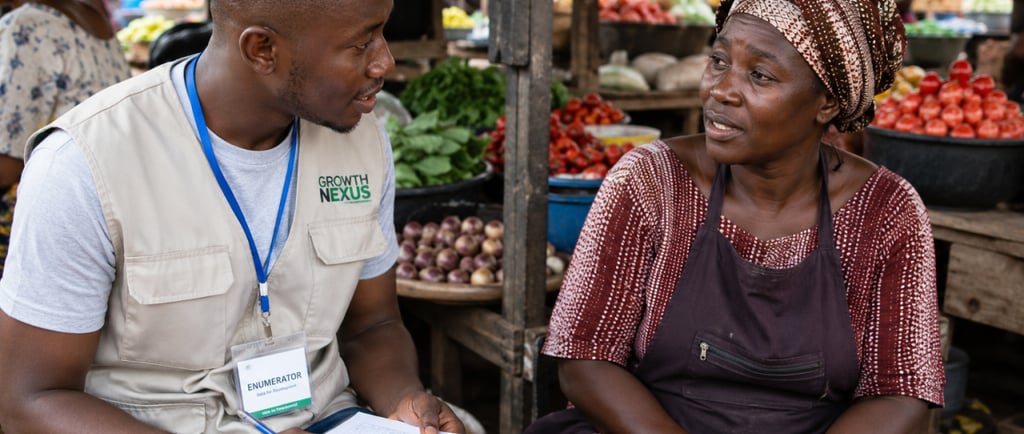
As we move closer to the 2027 elections, you will likely see more opinion polls from organisations such as ANAP Foundation, NOI Polls, SBM Intelligence, Harmattan Intelligence and others. And as always, the reactions will be predictable.
"How can they interview only 900 people and claim to know what 90 million voters think?"
"How can they survey only 100 local governments when Nigeria has 774?"
"Nobody asked me or anyone I know."
"The results must be fake."
These reactions are understandable. At first glance, polling a few hundred or a few thousand people in a country of over 200 million sounds ridiculous. But the truth is that surveys are not designed to speak to everyone. They are designed to speak to a carefully selected sample that represents everyone. To understand why this works, we first need to understand what research actually is.
What Is Research?
Research is the systematic process of gathering information to answer a question.
For example:
Which presidential candidate is currently leading?
Why are food prices rising?
Are Nigerians satisfied with electricity supply?
Which product do customers prefer?
How many young people are unemployed?
Research helps us move from assumptions to evidence.
Without research, decisions are often based on opinions, emotions, rumours, or social media trends.
Different Types of Research
Most research falls into two broad categories.
Quantitative Research
This focuses on numbers.
Examples:
Election polls
Customer satisfaction surveys
Population censuses
Employment statistics
Questions often include:
Who will you vote for?
How satisfied are you with government performance?
How many hours do you spend online daily?
The goal is to measure and quantify.
Qualitative Research
This focuses on understanding people's experiences, motivations, and perceptions.
Examples include:
Focus group discussions
In-depth interviews
Community consultations
Instead of asking "How many people support Candidate A?" qualitative research asks:
"Why do people support Candidate A?"
Both approaches are important because numbers tell us what is happening, while conversations help explain why it is happening.
Research Is More Than Election Polls
When many Nigerians hear the word "survey," they immediately think about election polling. In reality, surveys are used to understand almost every aspect of society, the economy, health, education, agriculture, and business.
For example, the annual employment and inflation reports published by the National Bureau of Statistics are based on large-scale surveys conducted nationwide. These studies help government, businesses, and development partners understand trends in jobs, prices, poverty, and economic activity.
International organisations also rely heavily on surveys. The World Food Programme uses household surveys and climate datasets to monitor food security and agricultural conditions. The Food and Agriculture Organisation conducts agricultural surveys to understand crop production, farming practices, and food systems. Similarly, the World Health Organisation and national health agencies conduct health surveys to track diseases, maternal health, vaccination rates, nutrition, and healthcare access.
Businesses conduct market research before launching products. Banks survey customer satisfaction. Schools evaluate learning outcomes. NGOs assess community needs before implementing projects.
At Growthly Nexus Solutions Limited, we recently conducted the 2025 Resilience & Resourcefulness Study to better understand the employment outcomes, skills, earnings, and career trajectories of technology-trained graduates. The objective was not simply to collect data, but to answer practical questions: Which skills lead to better employment outcomes? What factors influence income? How prepared are graduates for the realities of the labour market?
At first glance, these studies may seem very different. However, many of them are built on the same foundation: asking a carefully selected group of people questions and using their responses to understand a much larger population. This process is what we call a survey.
What Is a Survey?
A survey is one of the most common research tools.
It involves asking a group of people a structured set of questions and analysing their responses.
Surveys are used by:
Governments
Businesses
Political parties
Development organisations
Researchers
Media organisations
A survey can be conducted through:
Face-to-face interviews
Telephone calls
Online forms
SMS
Mobile applications
The Big Question: Why Not Ask Everyone?
Imagine you wanted to know which presidential candidate Nigerians prefer.
Nigeria has over 90 million registered voters.
Interviewing every voter would require:
Thousands of fieldworkers
Millions of phone calls
Billions of naira
Months of work
By the time the survey ended, public opinion might already have changed. This is why researchers use sampling.
What Is Sampling?
Sampling means selecting a smaller group that represents a larger population. Think about cooking soup. You do not drink the entire pot to know whether there is enough salt. You take one spoonful. If the soup is properly mixed, that spoonful tells you a lot about the entire pot. A survey sample works the same way. Researchers are not trying to talk to everybody. They are trying to talk to the right people.
Why Can 1,000 People Represent Millions?
This is where statistics becomes powerful. If a sample is properly selected, a survey of 1,000 to 2,000 respondents can often estimate national opinion surprisingly accurately. This is how polling works globally. In the United States, national polls often survey around 1,000 to 2,000 people to estimate the opinions of more than 300 million citizens.
The key is not the size of the country. The key is whether the sample reflects the country's diversity. Researchers, therefore, ensure representation across:
Gender
Age groups
Urban and rural areas
Education levels
Income categories
Regions and states
A carefully selected sample of 1,000 people is often more reliable than randomly interviewing 10,000 people.
Why Polling 100 Local Governments Can Still Be Valid
Many people assume every local government must be surveyed. That is not how sampling works. Suppose a doctor wants to test your blood. The doctor does not drain every drop from your body. A small sample is enough.
Similarly, researchers select locations that collectively represent national characteristics. The focus is not on covering every location. The focus is on achieving representativeness.
Why Poll Results Sometimes Look Wrong
Polls are not predictions. They are snapshots at a point in time. A poll tells us what respondents said at the time the survey was conducted. People can change their minds.
Campaigns can influence opinions. Economic conditions can shift. Major events can reshape public sentiment. A poll conducted today may not reflect voter behaviour six months later.
Who Pays for Surveys?
Another common question is:
"Who funds these polls?"
The answer is simple.
Research is quite expensive.
Surveys require:
Enumerators
Supervisors
Data analysts
Transport
Communication
Software
Quality control systems
As a result, surveys are often funded by:
Governments
Development partners
Media organisations
Political parties
Foundations
Private companies
Academic institutions
Businesses regularly pay for research before launching products. Political parties commission polling before campaigns. Development organisations conduct surveys before funding projects. Good research costs money because good decisions are valuable.
Can Polls Be Manipulated?
Yes. Like any tool, surveys can be abused. A poorly designed survey can produce misleading results. Common problems include:
Biased questions
Poor sampling
Small, unrepresentative samples
Selective reporting
This is why methodology matters. Whenever you see a poll, ask:
How many people were interviewed?
How were they selected?
When was the survey conducted?
What questions were asked?
What was the margin of error?
The best polling organisations publish these details openly.
The Real Lesson
The next time you see a poll showing that Candidate A is leading Candidate B, avoid asking:
"Did they interview everybody?"
That is not how surveys work.
Instead ask:
"Was the sample representative?"
Research is not magic.
It is not prophecy.
It is not mind-reading.
It is a structured attempt to understand reality using evidence rather than assumptions.
As Nigeria enters another election cycle, understanding how polls work will help citizens evaluate survey results more intelligently, ask better questions and engage more critically with the information being presented.
Because in the end, good decisions begin with good evidence.